Table of Contents
ToggleFarmhouse style has staying power because it balances warmth with simplicity. It’s about layering texture, celebrating natural materials, and creating spaces that feel lived-in without looking cluttered. Wall decor sets the tone for this aesthetic, it’s where raw wood meets vintage metal, where personal stories hang alongside flea market finds. The right approach doesn’t require a gut renovation or a designer’s budget. It calls for thoughtful choices, a few power tools, and an eye for pieces that add character without overwhelming the space. Whether someone’s working with a blank living room or refreshing a tired hallway, these farmhouse wall decor strategies deliver impact.
Key Takeaways
- Farmhouse wall decor combines warm, natural materials like reclaimed wood and wrought iron to create timeless spaces that work in any home style and budget.
- Installing shiplap or reclaimed wood accents requires basic tools—a stud finder, brad nailer, and miter saw—plus safety equipment like glasses and dust masks for a professional finish.
- Gallery walls become personal storytelling displays when you start with a focal anchor piece, mix complementary frame finishes, and maintain 30–40% wall coverage to avoid clutter.
- DIY farmhouse wall projects like ladder shelves, routed wood signs, and floating box shelves deliver custom character at a fraction of retail cost while reflecting your unique style.
- Metal wall art and industrial fixtures add contrast to farmhouse decor; always anchor pieces over 20 pounds directly into studs to ensure safety and prevent wall damage.
Why Farmhouse Wall Decor Never Goes Out of Style
Farmhouse design draws from agricultural heritage and practical construction, which gives it an inherent timelessness. Unlike trend-driven styles that cycle in and out, farmhouse decor relies on materials that have been used in homes for centuries, reclaimed barn wood, wrought iron, and natural fiber textiles.
The appeal lies in its flexibility. Farmhouse elements work in a modern loft, a suburban ranch, or a century-old cottage because they complement rather than dictate. Neutral palettes, whites, creams, soft grays, and weathered browns, serve as a foundation, allowing homeowners to layer in personal touches or shift accent colors without starting from scratch.
Another advantage: farmhouse decor scales to any budget. A single vintage window frame repurposed as wall art can anchor a room just as effectively as a full gallery wall. The style celebrates imperfection, which means DIY projects and secondhand finds fit right in. That’s a practical edge in 2026, when material costs and labor rates keep climbing.
From a design perspective, farmhouse wall decor creates visual interest through texture and depth rather than bold patterns. Shiplap, beadboard, and rough-sawn lumber add dimension without competing for attention. This makes it easier to balance functionality with aesthetics, critical for spaces like kitchens and mudrooms where walls need to work hard.
Rustic Wood Accents for Authentic Farmhouse Charm
Wood is the backbone of farmhouse wall decor. It brings warmth, texture, and a sense of history that painted drywall can’t match. The key is choosing the right application and finish for the room’s function and moisture exposure.
Reclaimed Wood Signs and Shiplap Panels
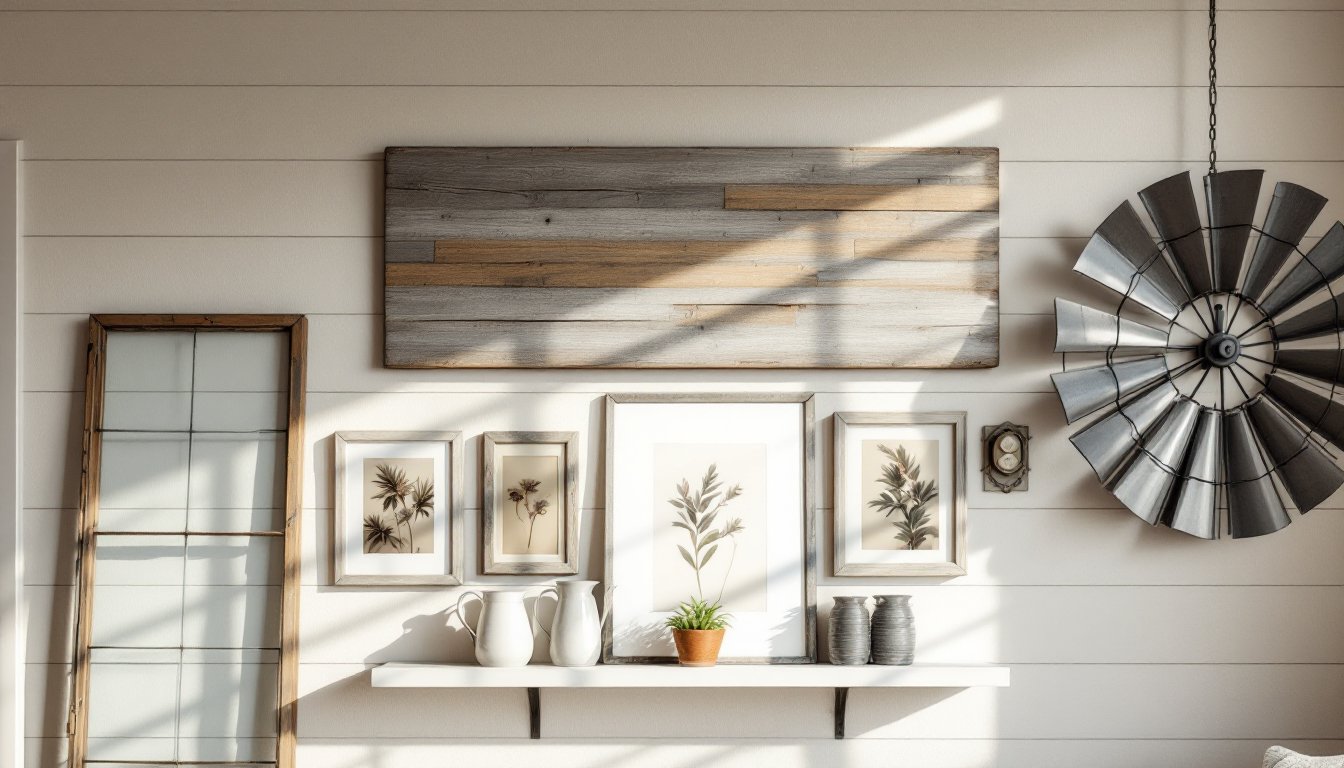
Reclaimed wood signs offer a straightforward entry point. Salvaged barn siding, pallet wood, or old fence boards work well, just confirm the wood is dry, pest-free, and free of lead paint if it predates the 1980s. Sand any rough edges with 120-grit sandpaper, then seal with a water-based polyurethane if the piece will hang in a kitchen or bathroom where humidity is a factor.
For larger impact, shiplap paneling creates a classic farmhouse backdrop. True shiplap features a rabbet joint along the edges, allowing boards to overlap slightly. Most DIYers use 1×6 or 1×8 pine boards (actual dimensions: ¾” x 5½” or ¾” x 7¼”) spaced with a nickel or dime for consistent gaps. Installation requires:
- A stud finder to locate framing (critical for secure attachment)
- 18-gauge brad nailer or finish nails driven into studs at 16″ or 24″ on center
- A miter saw for clean cuts (a circular saw works but requires a steady hand and a guide)
- Wood filler to conceal nail holes before painting
Paint shiplap with a flat or eggshell interior latex in soft white or greige for a traditional look. Skip the high-gloss finishes, they read too modern and highlight imperfections.
For accent walls, limit shiplap to one wall per room to avoid a theme-park effect. A bedroom headboard wall or a dining room feature wall works well. Full-room shiplap can make smaller spaces feel busy.
Safety note: Wear safety glasses and a dust mask when cutting and sanding wood. Pine dust is an irritant, and older reclaimed wood may harbor mold or chemical residues.
Vintage-Inspired Metal Wall Art and Fixtures
Metal elements introduce contrast and industrial edge to soften the wood-heavy farmhouse palette. Wrought iron, galvanized steel, and aged bronze finishes are go-to choices.
Vintage windmill blades, barn pulley systems, and metal farm signs bring authentic agricultural character when mounted as focal points. Salvage yards, estate sales, and online marketplaces often yield pieces for $20–$100, depending on size and condition. Before hanging, inspect for rust stability, surface rust adds character, but flaking rust will leave marks on walls and floors. Seal unstable rust with a clear matte spray lacquer.
For a cleaner look, metal wall grids or wire baskets offer functional storage while maintaining farmhouse aesthetics. Mount these with toggle bolts or molly anchors rated for the weight if studs aren’t conveniently located. A typical wire basket weighs 2–5 pounds: add the weight of contents when calculating load.
DIY metal wall art is accessible for those comfortable with basic metalworking. A simple project: weld or bolt together sections of ½” rebar or flat bar stock into geometric patterns (hexagons and rectangles work well). Finish with black spray paint or leave raw for a darker patina over time. This requires a MIG welder or access to a makerspace, plus welding gloves, a welding helmet, and proper ventilation.
Another approach involves combining metal and wood. Frame a reclaimed wood sign with a simple budget home renovation mindset by using L-brackets or angle iron as visible corner mounts. The contrast between organic wood grain and industrial metal hardware is pure farmhouse.
Code consideration: If mounting heavy metal art (over 20 pounds), verify wall construction. Drywall anchors have load limits: always anchor into solid wood framing for pieces that could cause injury if they fall.
Farmhouse Gallery Walls That Tell Your Story
A gallery wall is where farmhouse decor gets personal. Done right, it layers family history, art, and found objects into a cohesive display that feels curated, not chaotic.
Mixing Frames, Prints, and Personal Touches
Start with a focal anchor piece, a large vintage mirror, an oversized botanical print, or a salvaged window frame. This piece (typically 24″ x 36″ or larger) establishes scale and placement. Position it at eye level (57–60″ from the floor to the center of the piece), then build outward.
Frame consistency matters less than tone. Mix distressed wood frames, black metal frames, and whitewashed or cream frames, but keep the overall palette to three or four colors. Modern farmhouse decorating often incorporates black-and-white photography alongside muted botanical prints and hand-lettered quotes.
Layout options:
- Grid arrangement: uniform spacing (2–3″ between frames), same-size frames. Clean but can feel rigid.
- Salon-style: varied sizes, asymmetric spacing, organic feel. More forgiving for DIYers but requires a full layout on the floor first.
- Horizontal line: frames aligned along a central horizon line. Works well above a sofa or console table.
Before driving nails, create a paper template of each frame, tape them to the wall with painter’s tape, and step back to assess balance. This saves wall damage from repositioning.
Hanging hardware depends on frame weight:
- Under 5 lbs: standard picture hangers or finish nails
- 5–20 lbs: D-rings and wire with drywall anchors or stud mounting
- Over 20 lbs: screw directly into studs with #8 wood screws, 1½–2″ long
Personalize with three-dimensional objects: a small wooden shelf for displaying ironstone pitchers, a cotton stem wreath, or a vintage rolling pin hung horizontally. These break up the flatness and add depth.
Pro tip: Avoid overcrowding. Leaving some wall visible prevents the gallery from feeling cluttered. Aim for 30–40% wall coverage in the gallery zone.
Creative DIY Farmhouse Wall Decor Projects
DIY projects deliver custom farmhouse character at a fraction of retail cost. These builds require basic tools and intermediate skills.
Project 1: Ladder Shelf Display
An old wooden ladder makes a rustic wall-mounted shelf. Use a 6–8 foot stepladder or decorative orchard ladder. Secure it horizontally to the wall by screwing through the side rails into studs with 3″ lag screws and washers. The rungs become natural shelving for small plants, mason jars, or framed photos. Sand and seal with clear satin polyurethane if the wood is raw.
Project 2: Plank Sign with Routed Lettering
Create custom signs using 1×10 or 1×12 pine boards (actual width: 9¼” or 11¼”). Cut to desired length with a miter saw, sand smooth, then use a router with a V-groove bit to carve letters or designs. For those without a router, paint letters using a stencil and chalk paint for a matte, aged finish. Attach a sawtooth hanger or D-rings to the back.
Design inspiration from Better Homes & Gardens shows how mixing typography styles, script and block letters, adds visual interest without requiring advanced skills.
Project 3: Floating Box Shelves
Build simple shadow boxes from 1×4 pine for the frame and ¼” plywood for the back. Cut pieces to form a box (common sizes: 12″ x 12″ x 4″ deep), join with wood glue and 18-gauge brad nails, then mount with heavy-duty picture hangers or French cleats for a seamless look. Stain with dark walnut or weathered oak to contrast white walls.
These shelves work well in kitchens near a farmhouse sink installation to display vintage crockery or herb pots.
Project 4: Stenciled Accent Wall
For those hesitant about permanent changes, a stenciled pattern on a single wall offers farmhouse flair without the commitment of wallpaper. Use a large damask or geometric stencil and apply with a foam roller and latex paint one shade darker than the base wall. Work in small sections, taping the stencil firmly to avoid bleed. A low-tack painter’s tape prevents paint creep.
Safety gear for DIY: Always wear safety glasses when cutting or nailing, a dust mask for sanding, and work gloves when handling rough lumber. Ventilate the workspace when using stains, paints, or sealers, most products off-gas VOCs even if labeled low-odor.
Permit note: Wall decor projects rarely require permits unless they involve altering load-bearing walls or running new electrical for lighting. When in doubt, consult local building codes or a licensed contractor.
For design balance, Southern Living recommends mixing one large DIY piece with smaller store-bought items rather than filling every wall with handmade projects, which can overwhelm a room.
These DIY builds offer flexibility, allow for customization to exact dimensions, and create conversation pieces that reflect the homeowner’s skill and style.